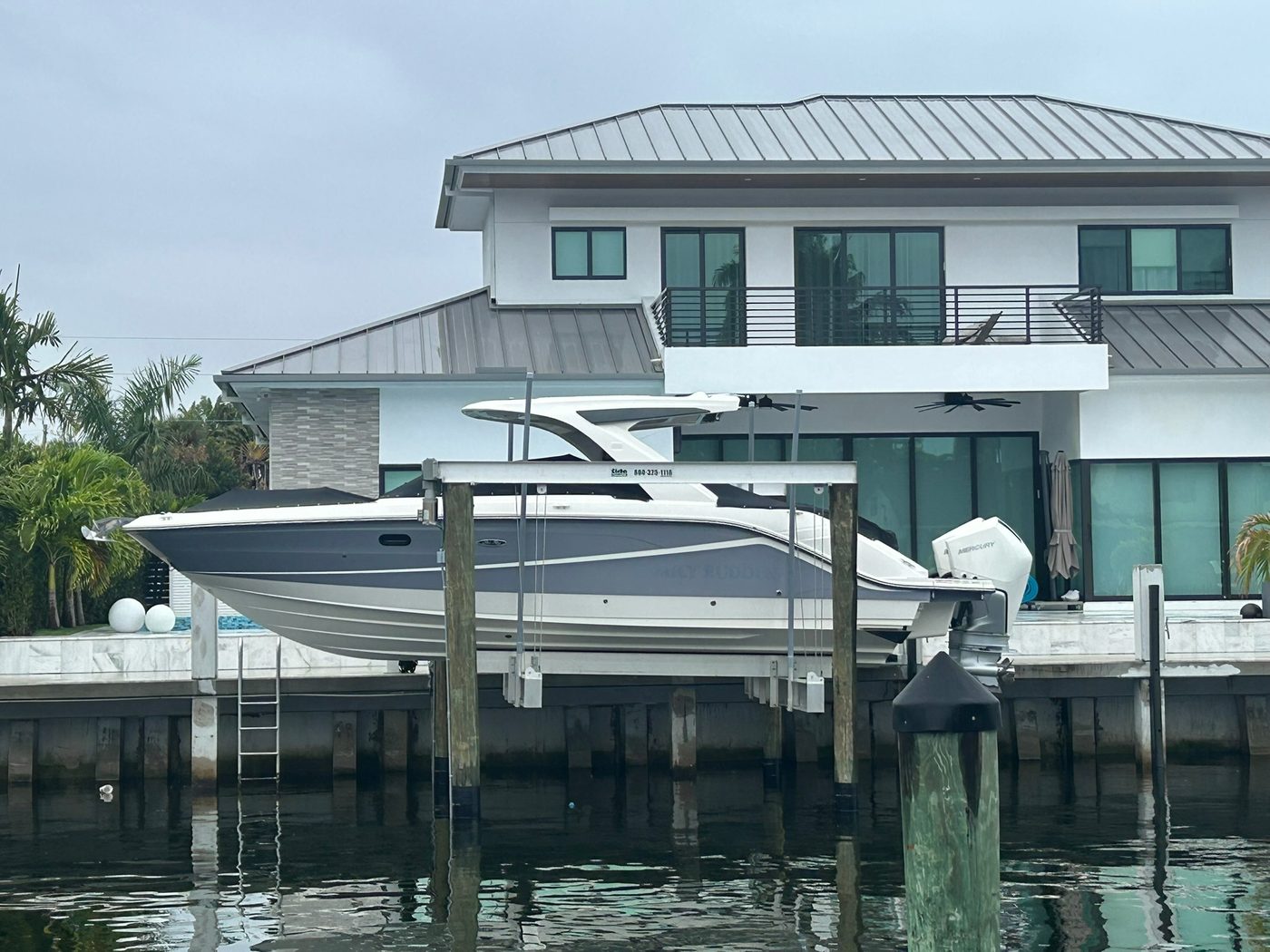
Most articles about boat lift sizing tell you the same thing: take your boat's dry weight, add 20%, pick the next-size-up lift. That math is fine as far as it goes. But it produces a lift that's barely right for the boat you own today — and almost guaranteed to be too small for the boat you'll buy next.
After installing boat lifts across Palm Beach and Broward County, the single most common conversation we have with new customers goes like this: "I bought a lift a few years ago for my old boat. I just upgraded boats. Now the lift doesn't have the capacity for the new one." That conversation usually ends with a full lift replacement — a cost the homeowner didn't budget for.
I had this exact call last month. A customer in Fort Lauderdale who bought a 20,000-lb lift from us three years ago — sized correctly for his boat at the time — just called to ask us to remove it and install a 35,000-lb lift. He upgraded to a much bigger boat. The math on his original install was right. The forecast was wrong.
This article will give you the conventional 20% rule (because it's still the foundation), then go a step further — what we actually tell Boca Raton homeowners who don't want to do this twice.
The 20% rule, explained properly
The industry-standard rule: your boat lift's rated capacity should exceed your boat's fully loaded weight by at least 20%.
Fully loaded weight is not the number printed on your boat's manufacturer spec sheet. That's dry weight, and it's deceptive. It excludes nearly everything that lives on your boat in normal use.
Here's what dry weight leaves out, and what each one adds for a typical 30-foot center console:
- Fuel — gasoline weighs ~6 lbs/gallon. A 200-gallon tank, full, adds 1,200 lbs.
- Fresh water — ~8 lbs/gallon. A 30-gallon freshwater system adds ~240 lbs.
- Batteries — Group 31 marine batteries run ~75 lbs each. Most center consoles run 3–4 batteries (225–300 lbs).
- Outboard engines — increasingly missing from "dry weight" specs. A pair of 300-HP outboards adds ~1,200 lbs. Quad 400-HP engines like you'll see on performance boats can add 2,200+ lbs over hull-only weight.
- T-tops, towers, and hardtops — 200–600 lbs depending on configuration.
- Gear — fishing tackle, rods, dive equipment, cooler, anchor and chain, dock lines, safety equipment. Easily 300–500 lbs for a serious fisher.
- Electronics — multi-screen helms, radar, autopilot, tower-mounted antennas can add 100–250 lbs.
A 30-foot center console with a published dry weight of 9,500 lbs frequently arrives at the lift weighing 13,500 lbs fully rigged. That's a 42% difference between spec sheet and reality.
The math: how to size correctly today
Here's the calculation:
- Start with manufacturer dry weight.
- Add fuel, water, batteries, engines (if not already included), gear, electronics, T-top or tower.
- The result is your fully loaded weight.
- Multiply by 1.20 (the 20% safety margin).
- Round up to the next standard lift capacity available from your dealer.
Worked example for a Boston Whaler 280 Outrage:
- Dry weight (with twin Mercury 300s): ~7,500 lbs
- Fuel (152 gal at 6 lb): 912 lbs
- Water (32 gal at 8 lb): 256 lbs
- Batteries (4 × 75 lb): 300 lbs
- Gear, electronics, T-top accessories: ~500 lbs
- Loaded weight: ~9,468 lbs
- 20% margin: 9,468 × 1.20 = 11,361 lbs
- Minimum lift size: 12,000 lbs.
That's the conventional answer. Now here's why we don't recommend stopping there.
Why "think ahead" matters more than the 20% rule
Boat ownership in Boca Raton follows a remarkably predictable pattern. The customer with a 24-foot center console in their forties usually owns a 28-footer in their fifties. The 30-footer becomes a 34-footer. The single-engine becomes twin. The casual boat becomes the serious fishing platform.
This upgrade cycle isn't an accident. It's how boating works. Bigger boats mean more comfort, more range, more capability — and once a homeowner has done one major upgrade, the next one is easier psychologically because they've already made peace with the cost.
The problem: a boat lift is engineered to a specific capacity. You can't "upgrade" it later. If your 12,000-lb lift was right for your current 30-footer, it's wrong for the 34-footer you'll buy in five years. Wrong for the twin-engine you're considering. Wrong for the addition of a tower.
The first question I ask every customer during a site visit isn't about their current boat — it's "What boat are you planning to have in two years? Or is this your forever boat?" Most people pause when I ask that, because they hadn't thought about it. A lot of boaters get what we call "one-foot-itis" — they always want something a foot or two longer than what they have now. If that's you, size the lift for the boat you'll actually want, not the one tied up at your dock today.
Sizing one or even two capacities above the strict 20%-rule number adds a modest amount to the upfront cost — but eliminates the much larger rip-and-replace cost when (not if) you upgrade boats. The math almost always favors sizing up.
What if you size too big?
There's a real downside to oversizing, but it's smaller than most homeowners assume:
- Slightly larger motors and electrical load — bigger lifts use bigger drive motors and pull more amps. Negligible cost difference over time.
- Heavier structural attachment requirements — bigger lifts may need stronger pilings or additional reinforcement to the seawall or dock. This is where oversizing can genuinely add cost.
- Dock space — bigger lifts have bigger footprints. A 16,000-lb lift takes up more linear feet of dock than a 12,000-lb lift.
For most Boca Raton waterfront properties, none of these are deal-breakers. The structural attachment issue is real but solvable — and a good contractor will tell you upfront if your dock can't handle a larger lift, before you commit.
Quick reference: typical sizes for Boca Raton boats
These are starting points only — your actual loaded weight may differ:
- PWC / Jet Ski — 1,200 to 1,800 lb capacity lifts. A loaded Sea-Doo with rider weighs ~1,100 lbs.
- 20–24 ft bay boats and small center consoles — 4,500 to 7,000 lb capacity. Fully loaded: 3,500–5,500 lbs.
- 25–28 ft center consoles and small cruisers — 7,000 to 10,000 lb capacity. Loaded: 5,500–8,500 lbs.
- 29–32 ft center consoles and cruisers — 12,000 to 16,000 lb capacity. Loaded: 9,500–13,500 lbs.
- 33–38 ft center consoles, cruisers, and performance boats — 20,000 to 30,000 lb capacity. Loaded: 14,000–25,000 lbs.
- 40+ ft sportfish, yachts, performance boats — 30,000+ lb capacity. Custom engineering territory.
Most Boca waterfront homes end up with lifts in the 12,000–24,000 lb range. PWC lifts often go alongside the main boat lift as a secondary install.
What we tell customers in Boca, specifically
Boca Raton has waterfront conditions that affect sizing decisions:
The Intracoastal and the canals are different environments. Canal-side homes (the majority of Boca waterfront) have calm water and predictable tides — sizing is straightforward. Intracoastal-facing properties get more boat wake and occasional chop, which means cradle stress under load. A capacity buffer matters more on Intracoastal exposure.
Saltwater corrosion is non-negotiable. Every Boca lift lives in saltwater. Over a 15–20-year service life, frame and component materials lose some of their original capacity through corrosion. A lift sized at the edge of its rating today will be undersized in 10 years.
Hurricane preparation factors in. A properly sized lift holds your boat above storm surge during a named storm. Undersized lifts get retired from service before they need to be — sometimes mid-hurricane warning. Sizing with margin gives you confidence the lift will still be operating reliably during the year it matters most.
Wake-zone properties need to consider lift speed, not just capacity. Homes on the Intracoastal or other high-wake waterways often deal with big boat traffic creating significant chop. For those properties we recommend a high-speed lift — one that can raise the boat out of the water quickly when a big wake is coming. A standard-speed lift can be perfectly capacity-rated and still leave your boat slamming into the cradles while you wait for it to come up. Speed matters separately from size.
The bottom line
If you're choosing between two lift capacities and can't decide, choose the bigger one. The cost of sizing up is small. The cost of sizing down is owning the wrong lift for the boat you'll have in five years.
The 20% rule is a starting point. The right rule is: size for the boat you'll own in five years, not the one tied up at your dock today.
A free on-site evaluation includes loaded-weight estimation, dock and piling assessment, and a recommendation across the five brands we install — so you're not getting a pitch for whatever happens to be in stock. Request an evaluation or call us at 754-SEA-WALL if you want to talk through your specific boat and dock.
Frequently asked questions
What is the 20% rule for boat lift sizing?
The 20% rule means your boat lift's rated capacity should exceed your boat's fully loaded weight by at least 20%. So a fully loaded boat at 10,000 lbs needs a lift rated for at least 12,000 lbs. The buffer accounts for uneven weight distribution, motor strain, and longevity in saltwater.
What is loaded weight vs dry weight?
Dry weight is the manufacturer's published number for the boat alone, often excluding engines, fuel, water, batteries, and gear. Loaded weight is what the boat actually weighs when you use it — typically 30 to 45 percent heavier than dry weight for a fully rigged center console.
How much heavier is a fully loaded boat compared to dry weight?
For a typical 30-foot center console, fully loaded weight runs 30 to 45 percent above published dry weight. Fuel, fresh water, batteries, T-tops, gear, and electronics all add weight that isn't included in manufacturer specs.
Should I size up for a future boat upgrade?
Yes, in most cases. Boat lifts cannot be capacity-upgraded after installation. Most boat owners upgrade boats within 5 to 10 years, often to a heavier model. Sizing one or two capacities above the strict 20% rule eliminates the cost of replacing the lift when you upgrade.
What is a high-speed boat lift?
A high-speed boat lift raises the boat out of the water faster than a standard-speed lift, which matters for properties on wake-prone waterways like the Intracoastal. Speed is rated separately from capacity — a properly-sized lift can still be too slow to protect your boat from incoming wake if it lifts at a standard rate.
What size lift do I need for a jet ski or PWC?
Most personal watercraft lifts run from 1,200 to 1,800 lbs capacity. A loaded Sea-Doo or Yamaha WaveRunner weighs around 900 to 1,100 lbs, so the standard PWC lift sizing gives adequate buffer.