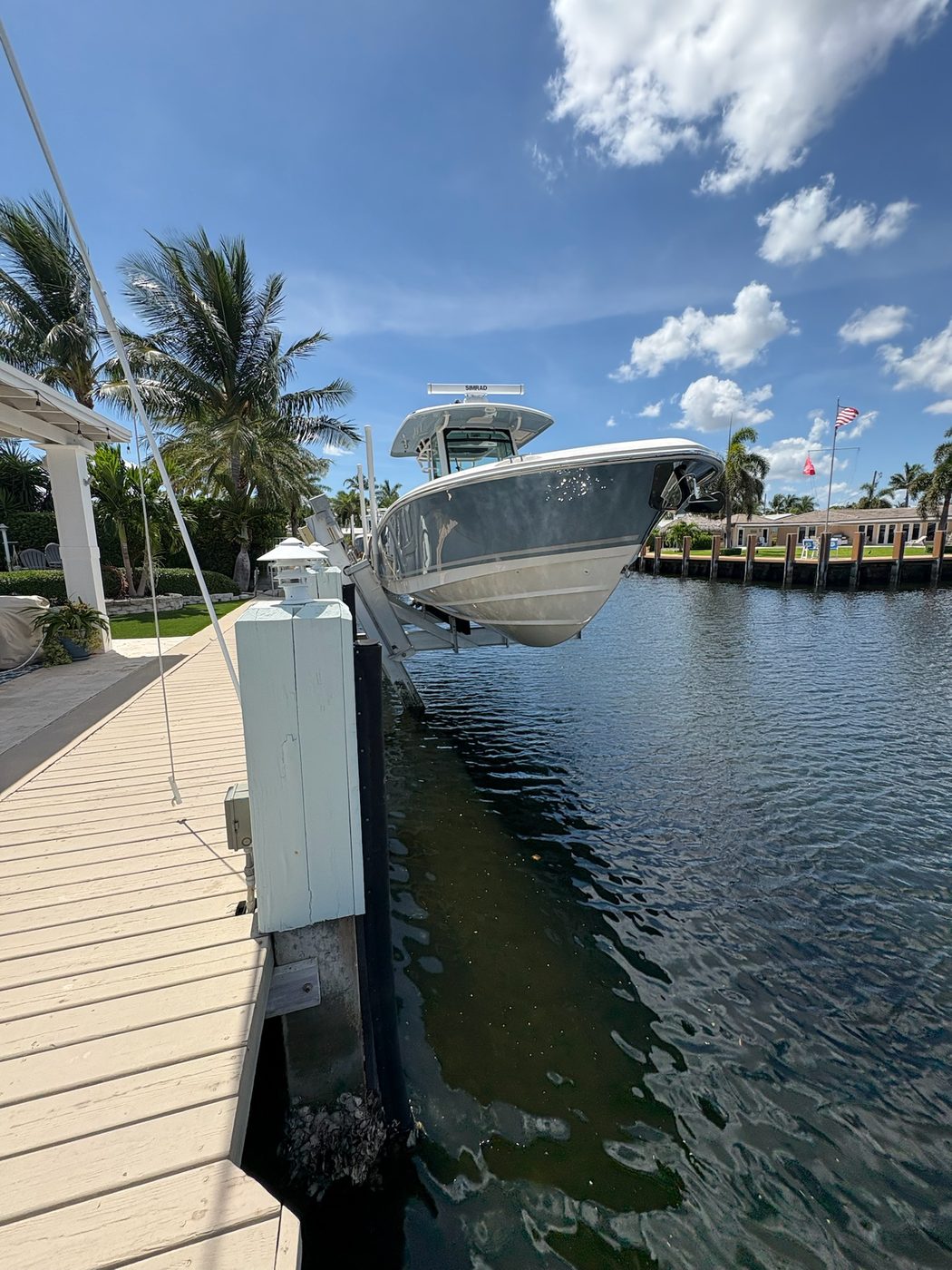
If you're shopping for a boat lift in Boca Raton, you'll get pitched one of two designs almost every time: a 4-post cradle lift or an elevator lift. The pitch you get usually depends on what the dealer carries — and almost every dealer carries one but not both.
That makes honest comparisons hard to find. So here's the version from someone who installs both, holds dealerships across both styles, and has no incentive to push you toward one or the other.
The basic difference
A 4-post lift (also called a cradle lift) suspends your boat in a cradle between four pilings driven into the seabed. The cradle goes down into the water, you drive the boat onto it, and it lifts straight up. The structure stands independently — it doesn't rely on your dock or seawall for support.
An elevator lift mounts to your seawall, your dock pilings, or both — typically along one side rather than surrounding the boat. The boat is lifted on an angled or vertical track, more like a parking-garage car lift than a cradle. No additional pilings required.
Different geometry, different engineering, different use cases.
4-post lift: where it wins
Capacity ceiling. 4-post lifts scale up cleanly to high capacities. Most residential 4-post lifts run from 4,500 lbs (PWC and small bay boats) to 30,000+ lbs (sportfish, large cruisers, performance boats). When you go heavier, the design extends to 6-post or 8-post configurations. Elevator lifts have practical capacity limits well below this.
Lower cost for a given capacity. For the same boat weight, a 4-post lift is typically less expensive installed than an elevator. The structure is simpler — four pilings, a cradle, motors, cables. Less engineering, less labor.
Independent structure. A 4-post lift doesn't add load to your existing seawall or dock. The pilings are driven into the seabed and bear the full weight. If your seawall is older or your dock framing is marginal, this matters.
Long service record. The 4-post design has been refined for decades. Parts are widely available. Every marine contractor in South Florida can service one. Failure modes are well understood. There's a reason most Boca lifts are 4-post — they work.
No aluminum permanently submerged. This is the advantage most homeowners never hear about. On a 4-post lift, the aluminum frame and cradle only contact saltwater intermittently — when the lift is lowered to receive the boat. The rest of the time, the structure is above the waterline. Aluminum that gets wet/dry cycled in saltwater corrodes far more slowly than aluminum that's continuously submerged. Elevator lifts, by contrast, have aluminum I-beam tracks that sit in saltwater 24/7. We'll get to what that means below.
4-post lift: where it falls short
Requires pilings. You need room for four pilings in the water, driven into stable seabed. Tight canals, dense piling fields from neighboring docks, or rock/coral seabeds can make this difficult or impossible.
Water depth. 4-post lifts need adequate water depth at low tide to clear the cradle. Shallow-water canals — anything under about 3 feet at low tide — can rule out a conventional 4-post.
Dock real estate. The lift footprint extends well beyond the boat itself. On a narrow dock or constrained slip, a 4-post can eat space you'd rather use for something else.
Permit complexity. Driving new pilings triggers full marine construction permitting — surveys, drawings, City review, and sometimes Florida DEP or Army Corps involvement depending on the property and waterway. More involved than an elevator install attached to existing structures.
Elevator lift: where it wins
No new pilings required. The single biggest advantage. Elevators mount to existing seawalls or dock pilings, which means installations on tight canals, deep-water properties where piling is impractical, and properties already at maximum pile count under local regulations.
Shallow-water capability. Because there's no cradle that needs to drop below the boat hull, elevator lifts work in water that's too shallow for 4-post designs. Critical for some Boca canal-end properties and dead-end slips.
Compact footprint. The lift occupies only the dock or seawall face it's mounted to. The water in front of the lift stays clear of structure — useful if you have other watercraft, swimmers, or want unobstructed views.
Side-loading flexibility. Many elevator designs let you load the boat from the side rather than driving onto a cradle from the end. In a tight slip with limited maneuvering room, this can be the difference between a usable setup and a daily fight.
Faster permitting in some cases. Since no new pilings are being driven, some installations qualify for simpler permit processing — though this varies by jurisdiction and the specifics of the property.
Elevator lift: where it falls short
Capacity limits. Most residential elevator lifts cap out below the heaviest 4-post designs. Customers with very heavy boats — large cruisers, sportfish over 40 ft, performance boats with quad outboards — usually have to go 4-post or custom.
Higher cost for equivalent capacity. Elevators run more expensive than a comparable 4-post lift, largely because of the more complex drive system and the structural requirements of mounting to an existing seawall.
Adds load to your seawall or dock. Since the lift mounts to existing structures, those structures must be capable of bearing the load — boat included. Older seawalls or marginal dock framing may need reinforcement before an elevator install is feasible, which adds cost and complexity.
More mechanical complexity. Drive systems, track alignment, and mounting hardware introduce more potential failure points than a 4-post. Maintenance frequency tends to be higher, and repairs can be more involved.
Fewer service options. Not every marine contractor in South Florida is comfortable servicing elevator lifts. If you buy one, plan to service it through a dealer who actually installs them — not the generic dock-repair company you might call for routine maintenance.
Aluminum I-beams permanently submerged. The defining engineering tradeoff of an elevator lift: the aluminum track structure is continuously in saltwater. The carriage rides up and down on submerged I-beams, which means accelerated galvanic and oxidative corrosion compared to a 4-post lift whose aluminum only gets wet during loading cycles. Manufacturers compensate with sacrificial zinc anodes that have to be inspected and replaced regularly — and the corrosion clock is always running. Over a 15-to-20-year service life, this matters.
How to decide: the questions that actually matter
Forget the marketing on each manufacturer's website. The decision usually comes down to a handful of practical questions:
1. Can you drive new pilings? Check water depth at low tide, available space between your dock and your neighbor's, and any local restrictions on piling counts. If pilings are feasible, 4-post is almost always the better choice.
2. How heavy is your boat — now and in five years? If you're already pushing 25,000+ lbs loaded or plan to upgrade to that range, you're probably committed to 4-post regardless. Elevator capacity ceilings will limit your options.
3. How's your seawall? If you're considering an elevator, an honest contractor will inspect your seawall's condition and engineering before recommending it. Older seawalls or marginal construction sometimes need reinforcement first. Factor that into the total cost.
4. What does your dock layout look like? Wide slip with room for pilings? 4-post. Narrow canal with neighbor pilings already close? Elevator. Dead-end slip with shallow water? Elevator. Standalone dock far from the seawall? 4-post.
5. What's your tolerance for maintenance complexity? 4-post lifts are mechanically simpler. If you want a lift you can mostly forget about between annual services, that's a point for 4-post. Elevators need more attentive ownership.
What we install most often in Boca
The honest split for residential Boca Raton installs is heavily 4-post. Most properties have enough space for pilings, most boats fit within standard capacity ranges, and most owners prefer the simpler maintenance profile.
Elevator lifts become the right answer for a specific minority of sites — usually canal-end properties, shallow-water slips, or homes where neighboring docks have eaten the piling space. When the site demands an elevator, an elevator is the right call. When the site doesn't demand one, a 4-post is usually the better value.
Bottom line
If you're choosing between styles, the question isn't "which is better in general." It's "which is right for my specific dock, my specific boat, and my specific upgrade plans." A free on-site evaluation will tell you in under an hour.
The wrong answer to this question costs $20,000–$40,000 when you have to redo the install. The right answer takes a site visit and an honest conversation.
Request an on-site evaluation or call 754-SEA-WALL — we install both styles across all five of our authorized brands, so the recommendation you get is based on your situation, not our inventory.
Frequently asked questions
What is the difference between a 4-post lift and an elevator lift?
A 4-post lift suspends your boat in a cradle between four pilings driven into the seabed and lifts the boat straight up. An elevator lift mounts to your seawall or existing dock structure on one side and raises the boat along an angled or vertical track. Different geometry, different use cases.
Which is better, a 4-post or elevator boat lift?
Neither is universally better. 4-post lifts win for capacity ceiling, lower cost, and structural independence from your dock. Elevator lifts win for shallow water, tight canals where you can't add pilings, and side-loading flexibility. The right answer depends on your specific dock and boat.
Is an elevator boat lift more expensive than a 4-post?
Yes. For equivalent capacity, elevator lifts cost more than 4-post lifts. The drive system is more complex and the structural mounting requirements are more involved. Cost difference varies by brand and capacity but elevator lifts are consistently the more expensive option.
What's the maximum capacity for an elevator boat lift?
Residential elevator lifts cap below the heaviest 4-post designs. Customers with very heavy boats — large cruisers, sportfish over 40 feet, performance boats with quad outboards — typically need a 4-post or custom solution rather than an elevator.
Can a boat lift be installed without driving new pilings?
Yes, with an elevator lift. Elevator lifts mount to your existing seawall or dock pilings, which is why they're often the right answer for properties where new pilings aren't feasible — tight canals, dense piling fields, or shallow water.
Which boat lift style is more common in Boca Raton?
4-post cradle lifts are far more common in Boca Raton residential installs. Most properties have enough space for pilings, most boats fit within standard 4-post capacity ranges, and most owners prefer the simpler maintenance profile.